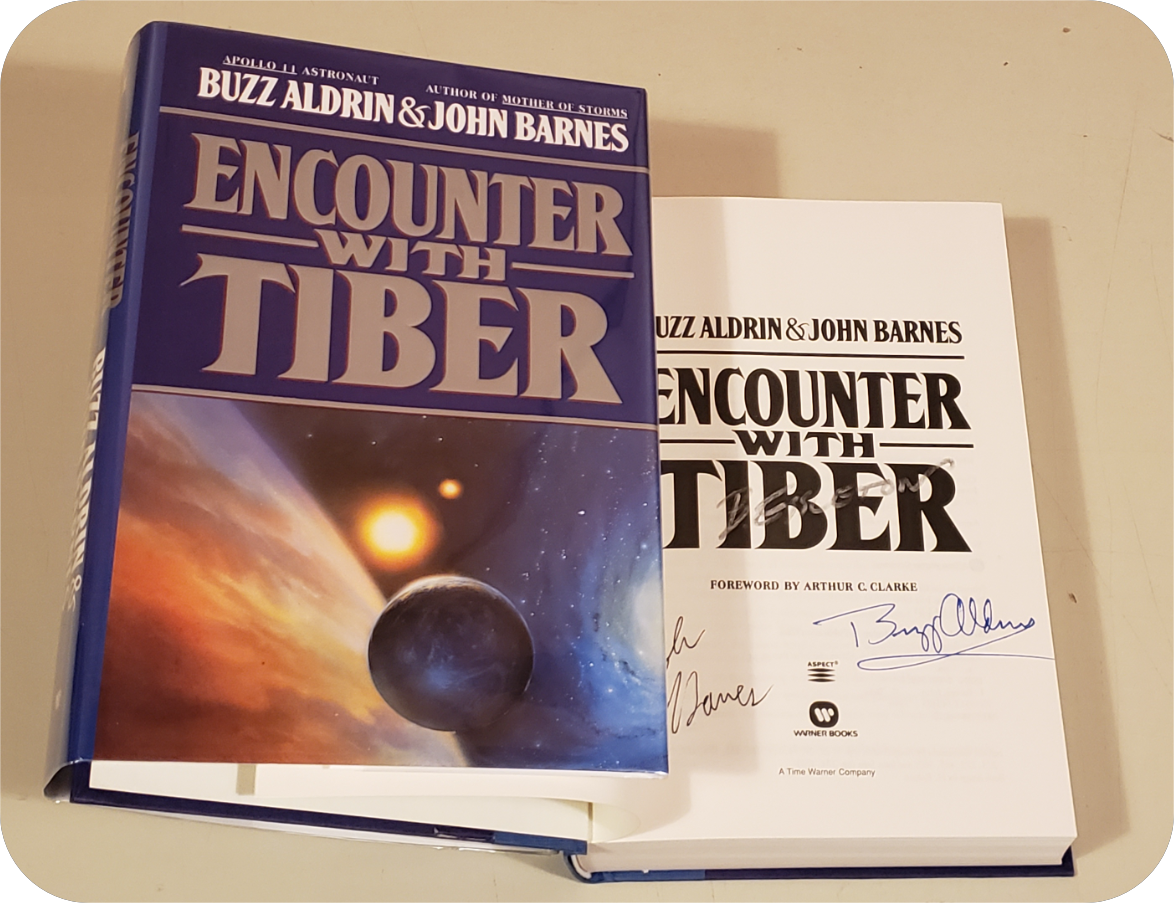
Every year as December winds down, I try to close with a book on a topic which is very close to my heart, a ritual I have been trying to do for some time now. This time, the book found me. I thought I’d close with Spaceman but then landed with Encounter with Tiber. It was first published in 1966 by former astronaut Buzz Aldrin and science fiction writer John Barnes. And the book didn’t disappoint me, by page thirty I knew I wasn’t just reading science fiction, I was in fact, traveling.
This is my first time reading something by Buzz Aldrin. Just hearing his name sounded familiar to me since he was the second man to walk on the Moon. When I found out the book was about an alien civilization, a lunar archaeology mission, and traveling through space, I was already interested and wanted to keep reading.
Past, Present, and Alien History All at Once
The novel opens with historian Clio Trigorin, born on Mars, boarding the starship Tenacity in 2069, which is 100 years after Apollo 11. She is not a pilot or a soldier, but a thinker who cares deeply about memory, history, and how civilizations are remembered.
I think when, in the near future, humanity starts to live on distant planets, this urge to think about our roots on Earth might grow even stronger, reminding us of where we came from and what we carry with us across the stars. Especially for those who are born on distant planets and never on Earth, they might still wonder about how humanity began its journey from Earth, or maybe they would not. Either way, the desire to understand our origins and history could become an important part of their identity.
Clio’s trip to Alpha Centauri is the first time humans have traveled to another star, but it is also a journey of self-reflection.
Humans already know that they will find the ruins of an alien civilization called the Tiberians. Therefore humanity’s first interstellar journey is not about finding new life, but about discovering what remains of one. This is the first time I came across a science fiction novel that explores the past of another civilization instead of discovering a new one.
I think a similar idea can be found in Rendezvous with Rama by Arthur C. Clarke. Although I have not read the book yet, I once briefly looked at the plot and noticed some similarities.
The story, Encounter with Tiber, does not move in a straight line. It moves back and forth in time and slowly connects different events. The story shifts between Clio’s mission, the early years of future space exploration, and the history of the Tiberians. The authors connect these parts very smoothly, helping readers feel how fast human history is moving forward. In fact, as the story progresses, the pace becomes quicker, making everything feel faster and more intense.
Chris Terence, the Tiberians, and a Universe That Reminds Us of Ourselves
The early parts of the novel take place in the early 2000s and it talks about an astronaut named Chris Terence. He is an idealist and hopeful, but he has to deal with government rules, media pressure, and personal loss.
He helps build the first lunar base near an area later called Tiber. The technical details in these sections feel very accurate, similar to the realism found in Contact by Carl Sagan. This is because Buzz Aldrin’s real engineering experience clearly shows in the descriptions of spacewalks, docking scenes, and radio delays.
Then the story shifts far into the past and across space to tell the history of the Tiberians. Their civilization was destroyed by repeated asteroid impacts. These chapters are powerful and thought-provoking. They act like a mirror to humanity, showing how ambition and destruction happen again and again.
Readers who enjoyed the serious and emotional tone of The Three-Body Problem or Foundation will find a similar feeling here, where civilizations are shown as temporary and fragile in a vast, uncaring universe.
Experiencing the Universe Through Words
For me science fiction is like a mirror of technological development. Although it has the word “fiction” in it, in reality it’s not, as it often reflects real possibilities.
When Clio thinks that traveling at top speed now takes only seconds to cover a distance that once took Apollo three days, she is not showing pride. Instead, she is expressing how progress can sometimes take away the sense of wonder. Her words,
“at our top speed we’ll take seconds to cover the distance that once took Apollo three days”.
This simple thought truly gave me chills!
Then the book talks about propulsion physics, Casimir lasers, and Zero Point Energy. I do not fully understand these concepts and only have a basic knowledge of them, but that did not stop me from enjoying the story. It reminded me of Tau Zero by Poul Anderson, where extreme physics pushes a spacecraft beyond normal limits, not just to showcase scientific ideas, but to explore how humans react when technology carries them into the unknown. In both cases, the science feels less like a lesson and more like a tool to think about time, distance, and humanity’s place in the universe.
Books like these are so well written that readers like me do not need a VR headset to feel the thrill of traveling through space. I could imagine the stars rushing past, the tension of a risky maneuver, space getting both endless and close at the same time, and the wonder of standing on worlds far beyond Earth, not to miss the awe of discovering something ancient and alien. Reading it made me reflect on how small we are, yet how curious and determined we remain, trying to reach farther than we ever have before.
As I was reading the book, the plot was bouncing between the following three eras:
- the Moon missions
- the discovery of alien graves
- the Mars expeditions that dig up Tiberian relics
While, the common denominator for me was the feeling of human persistence. Be it any field, every generation builds upon the last, isn’t it?
And here, every mission is someone’s memorial and someone else’s beginning. Thus, it shows that progress is not just about technology, but about carrying forward the memory, effort, dreams of those who came before and learning from them to guide future generations in their own journeys.
The Gods Are Gone, the Tools Remain
When the story finally moves completely to the Tiberians’ point of view, the change in tone is quite visible. The aliens are not scary any more nor are they close to godlike creatures, their behaviour and the manner they operate seems similar to us.
For instance, their society is divided between the continents of Shulath and Palath, and they act on the same drives that humans do, which is:
- pride in their country
- creativity
- curiosity
- short-term politics.
Their downfall does not come from being evil or foolish, it happens because they are limited. Every few centuries, a swarm of asteroids called the “Intruder” destroys much of their progress, forcing them to rebuild and hope all over again. This is similar to Isaac Asimov’s Foundation series, where human civilizations rise and fall over long periods, showing that even advanced societies are fragile and shaped by forces beyond their control. I wrote a piece extending this thought process, titled, How Systems Predict and Control Civilization.
The Tiberians’ starships, powered by tapped vacuum energy, cross to other worlds to preserve their species. Mars receives them. The Moon receives them. Even Earth, where they encounter early humans.
The result feels like the inverse of Clarke’s 2001: A Space Odyssey, instead of godlike aliens guiding us, here the gods die first, leaving us their tools and warnings.
Books like these give a different perspective, or I’d say the other side of the story, and reading it made me think about how fragile and fleeting even the greatest civilizations are. It reminded me to appreciate the progress and knowledge we inherit, and how important it is to use it wisely before it is lost.
Moments That Made Me Stop and Just Breathe
There are three scenes in the book that moved me the most, and I want to highlight them. These are my favorite and most emotional parts. Words cannot fully express what they mean to me.
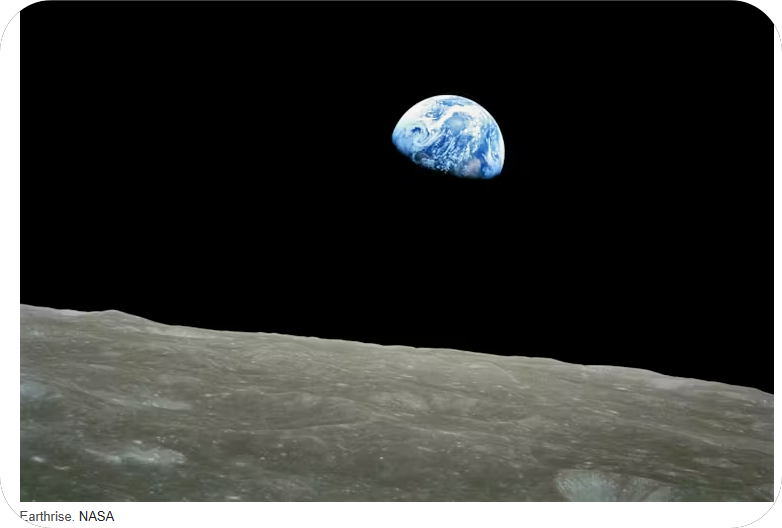
There’s a scene early on when Clio looks at Earth shrinking behind Tenacity, her starship, for the last time. She looked back not coz of nostalgia, but because it was a conscious act of preservation.
Whenever we move forward, be it leaving home or venturing into the unknown, we owe something to the past and to the place or people we’ve left. I think it evokes a sense of continuity, though we may not express it consciously. And in Clio’s moment, it suggests that even as humanity races toward the stars, it can’t truly sever itself from Earth. Looking back is her way of paying respect to the world and history that made departure possible, a quiet ethical gesture saying, we remember who we are because of where we came from.
“It’s less a farewell than a historian’s reflex, a deliberate act of remembering before the unknown erases the view.”
Later, when the Martian archaeologists drill through ice in Crater Korolev (an ice-filled impact crater in the Mare Boreum quadrangle of Mars,) and find the alien Encyclopedia gleaming under their lights, there’s a hush. The “hush” isn’t just reverence, it’s the dawning recognition that knowledge can survive extinction.
That buried object represents communication across eons, turning science into communion. Ice here represents the way time preserves meaning until someone patient enough learns to listen. The archaeologists aren’t just digging, they’re resurrecting a civilization’s memory, and by extension proving that discovery is also an act of continuity. The tension here is extraordinary, the human instinct for conquest suddenly replaced by humility.
“In that breathless quiet, the frontier becomes an archive; progress slows into reverence. They aren’t claiming a relic—they’re inheriting a responsibility.”
And then the ending. Humanity travels across four light-years only to find a message left millennia ago that reads like an open hand. The box shrinks the galaxy into an intimate exchange, an alien civilization saying what every vanished culture has longed to say: Remember us, and come find us.
“In that fragile box, the infinite becomes personal—a conversation between eras that never overlapped, and yet somehow recognized each other.”
The frozen landscape amplifies the warmth of the message inside, making the whole scene feel less like hard science fiction and more like unspoken camaraderie, reminding me that even across space and time, connection and understanding can survive.
Takeaway
As I mentioned above, the three scenes that moved me the most gave me a lot to think about. I have about four main lessons or takeaways from the book.
The first thing that comes to my mind is, how easily we romanticize innovation yet quietly forget the cost of getting here. Every new frontier risks erasing the fingerprints of those who made the first map. Encounter with Tiber made me feel that progress isn’t just about reaching, it’s about remembering who first wanted to.
Clio’s ship carries not just people but archives, the human record in transit. That image stayed with me. We’re so good at building engines, so clumsy at building remembrance. Maybe that’s what the book is about!
Secondly, I don’t know if I’m being over ambitious, but civilisations can only survive if there is not just one world.
The Tiberians failed partly because they put too much faith in one world. Reading that, I realized how vulnerable our own species feels when imagined from orbit, just a blue dot. One world, can’t hold forever.
Thirdly, do we actually deserve the world and the resources we already have? Apollo footprints on the Moon represent incredible human accomplishment, but on Earth, many problems like inequality and lack of care still exist. Maybe exploration isn’t just about conquering or showing power but also about responsibility, and gratitude, not claiming or taking things for granted.
And fourthly, the Tiberians, long extinct, still found time to leave a map and a message that simply said: We’re still out here. Come find us. That’s an act of faith across millennia.
When I finished the book, I thought about how much of human progress depends on gestures like that, letters, recordings, seeds, the small artifacts left for those who will never meet us.
I think we think about hope in the word way, it isn’t an emotion, it’s a discipline.
And reading this story as the year ends, I felt the baton being pressed softly into our hands. What we do next decides whether hope continues its orbit.
We have private rockets landing on barges, probes sniffing exoplanet atmospheres, AI copilots planning real interstellar mission concepts. Written in 1966, the book feels like a prophecy. Yet it also reminds me that technology alone doesn’t save civilizations. Memory, humility, continuity and the wisdom to use knowledge responsibly are just as important.
I finished the last page yesterday after midnight, closed the book, and just sat there for a while. Outside the window, for a moment I imagined Clio Trigorin’s starship passing between those lights, carrying our species’ next chapter on board.
If you’ve ever looked up and felt both awe and loneliness, if you’ve ever wanted to understand what space really means beyond the headlines and rockets, you should read this book. It’s big, ambitious and the kind of story that makes you measure time not in years, but in orbits.
And if you finish it at the end of your year too, maybe you’ll feel what I felt, the sense that while the stars outlast us, we’re still part of the same story. We always have been.